
There’s lots of bad takes and confusion on all sides about “free speech” and its relation to Twitter/social media. Free speech is a principle limiting government, not corporations. No social media platform would be usable if it used the 1st Amendment as a moderation guide, which Musk is quickly discovering.
▪️Some obvious examples of protected free speech that shouldn’t be allowed on a platform like Twitter include: pornography, doxxing, spam, bots/fake accounts used to artificially amplify something.
▪️Each of these would be protected speech from government interference, but if allowed unfettered on a social media platform would completely ruin the user’s experience. It would result in a cesspool, not a place where ideas are freely discussed and exchanged.
▪️What free speech advocates should want is a platform with a free speech “spirit.” A place where people can vigorously express all sorts of ideas, where the rules are clear and enforced objectively, not arbitrarily and without transparency.
▪️The problem with Twitter et al is their enforcement clearly favored some points of view over others. For example, Covid “disinformation” bans or the shutdown of the Hunter Laptop story. Even worse, the collaboration with government in enforcement (which is a free speech issue).
▪️The reason why we want places like Twitter to have vigorous, robust exchanges of ideas is that’s the best (sometimes only) way many of us have to discover the truth about what’s going on in the world.
▪️There were so many stories (Covington kid, Jussie Smollett, Russian collusion, Kyle Rittenhouse, etc) where the initial corporate media narratives were shot full of holes by internet sleuths and the sharing of evidence/battle of information on social media.
▪️If you knew where to look on Twitter, you were far ahead of the game on these issues than if you just read the NYT. There are some stories, like Rittenhouse, where you’d probably never get the truth without alternative voices on social media (like you found on this page).
▪️Of course, this can also go in the reverse direction, where people fall for false and misleading information and go down crazy rabbit holes. Finding the truth is hard, and the reality is many will fail at it. But finding the truth is impossible without a free exchange of ideas.
▪️The principle of free speech demands that no one use force to infringe upon another’s right to speech. Which primarily means curtailing government censorship attempts. The “spirit” of free speech means that a place respects and fosters the vigorous exchange of ideas.
▪️For example, a debate society has a free speech spirit, but with rules. They generally don’t allow the audience to shout at the debaters, blare music, or engage in sex acts during the debate. This would destroy the experience and harm its very purpose.
▪️Upholding free speech principles while also upholding rules on speech in one’s house are not conflicting ideas. It’s recognizing that the owner rightfully manages their own property, and allowing all 1st amendment speech in your home would turn it into a cesspool.
So many of these right wing accounts are just whiners now, this is a diatribe about automatic sinks and towels, the horror! As I explained in a prior post, most of the newer terminals have great bathrooms, some now have completely private stalls and plenty of them. The worst and most crowded airport bathrooms are invariably found in aging terminals that are decades old. It’s a reminder that airports were usually drab and uncomfortable.
I think the heyday of the air hand-dryers was like 15-20 years ago, where often you couldn’t find real towels. Now you can at least usually get real paper towels in airport bathrooms. Remember those old cloth roller towels that would go in a loop and somehow “clean” themselves? Yuck! Public bathrooms have always been gross, it seems some are deliberately having selective memories.
Airport food and drinks were always expensive, but now practically everyone brings those huge cooler flasks with them and fills them up. So not sure what he means that ...

I first critiqued this terrible take by looking at how food has actually improved substantially. Even though I said the same could be done in every category, people said “you’re only doing food.” So let’s do air travel and see why it’s not gotten better, not worse.
▪️Aircraft have greatly improved. Just 15-20 years ago, many domestic routes (~15%) were flown by turboprops like the Brasilia, Dash 8 or Saab. Now, almost everything is in jets, and most aircraft have WiFi. Some even have Starlink, where you probably have faster WiFi than your home. Most major airlines offer dozens or hundreds of movies and shows to watch.
▪️Newer designs like the 787 have lower cabin altitudes and improved humidity, which make a huge difference in passenger comfort on long haul flights. The first/business class international market has gotten very competitive globally, with many carriers offering excellent service and amenities. Pods, suites, showers, etc. Coach still sucks but is dramatically cheaper ...
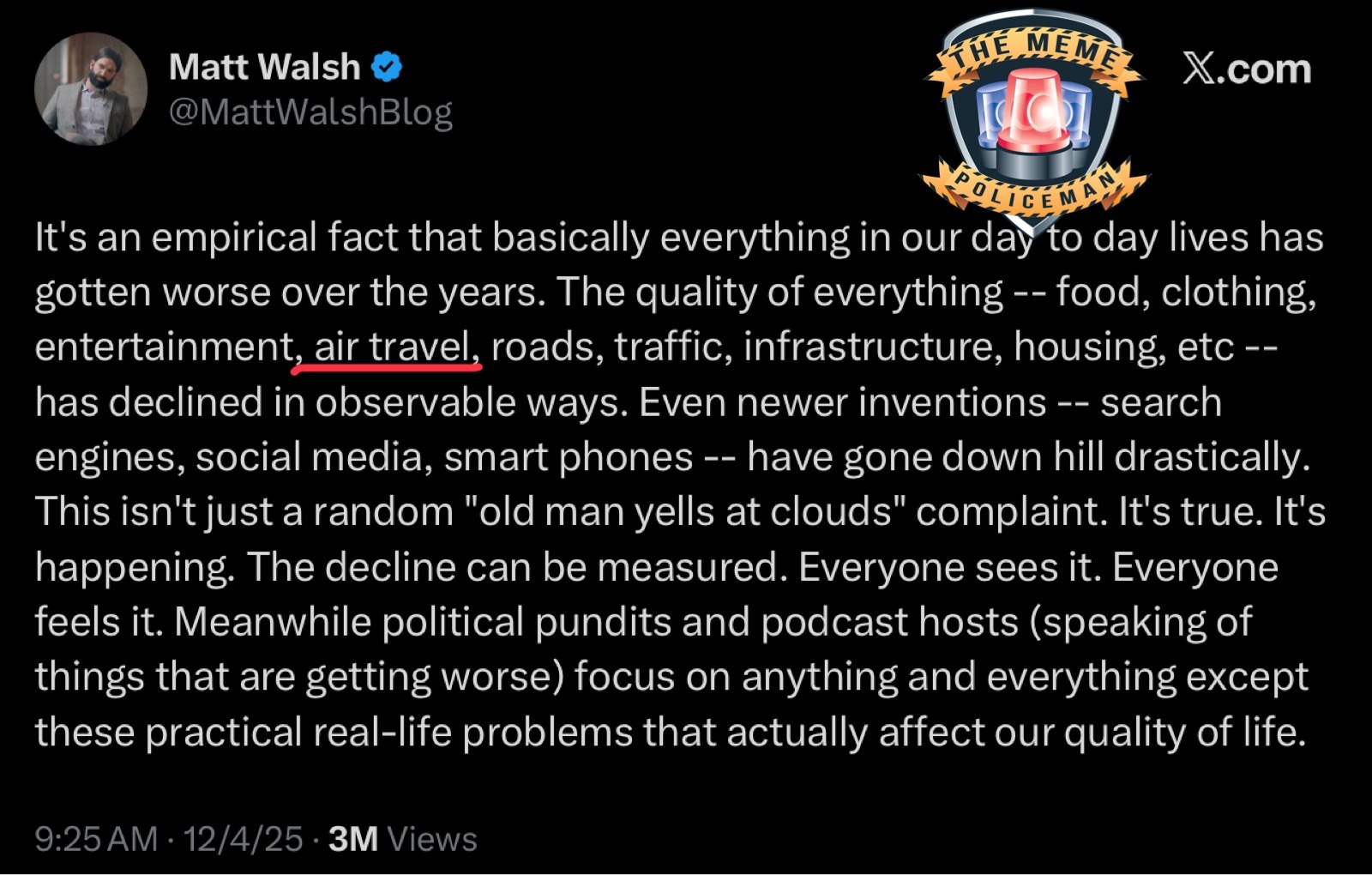
This is the complete opposite of an empirical fact. The right has now joined the left in being pessimistic about the modern world and completely unappreciative of the amazing abundance we now have. I’ll just focus on food here, but you could do it for almost every category.
▪️Fresh produce used to be available only in season. In the winter it was canned or frozen. People used to send fruit for Christmas gifts, it was that much of a luxury good. Now, you can get giant, sweet berries year around in every grocery store. Corn on the cob in February. Not to mention once rare items like dragon fruit, heirloom tomatoes or baby bok choy.
▪️If you didn’t live on the coast, seafood was either not available, frozen, or extremely expensive. If you lived in the Midwest and traveled to coastal locales you would quite literally be able to eat food you had never seen. Salmon has become much more abundant and accessible. You can get fresh ahi at Walmart today. Sushi and oyster bars exist everywhere ...